
March 24, 2012
The originality of the species | Books | The Guardian
http://www.guardian.co.uk/books/2012/mar/23/originality-of-species-ian-mcewan
– might be a tad clumsy!
March 20, 2012
Living on the fringe can make people sick
Living on the fringe can make people sick
March 15, 2012
OPINION
Read later
Public health must be an objective of urban planning.
AFFORDABLE housing is something that every state government likes to say it has delivered, and every opposition likes to say is no longer attainable. The prospect that home ownership might slip from the grasp of most people is so potent a political threat that in recent decades governments of both persuasions have yielded to pressure from developers to release cheap new land on the urban fringe.
As we report today, however, the relentless expansion of the urban boundary is itself imposing a massive cost on taxpayers, in the form of chronic health and social problems in the new suburbs.
In evidence presented to the Legislative Council’s environment and planning committee, outer suburban councils have presented an alarming picture of poorly planned housing developments without basic community services. In parts of the City of Wyndham in Melbourne’s west – the fastest growing municipality in Australia in percentage terms – people have either no or very little access to public transport, coupled with insufficient parkland and leisure facilities.
Advertisement: Story continues below
The consequence is that they have to use cars for even the simplest trips outside the home. For some residents, a visit to the nearest swimming pool might take 1½ hours on public transport, compared with 15 minutes by car. Some areas are even poorly supplied with supermarkets and other sources of fresh food, making residents reliant on service stations and fast-food outlets.
February 19, 2012
Frank Gehry: Theres a backlash against me | Art and design | The Observer
Frank Gehry: Theres a backlash against meFrank Gehrys success with the Bilbao Guggenheim sparked an inevitable backlash, but, as he says, expression is still vital to architectureShare 18 reddit thisComments 6 Rowan MooreThe Observer, Sunday 19 February 2012Article historyEight Spruce Street, left, the tallest residential building in Manhattan and Gehry?s first skyscraper. Photograph: Wade Zimmerman/Arcaid/CorbisThere are iconic architects and there is the architect who is the icon of iconic architecture. Whether he wanted to or not, Frank Gehry, as the creator of the titanium-clad Bilbao Guggenheim, made the original for 10,000 wannabes – pointy, swooshy, shiny things, would-be masterpieces that proclaimed regeneration for whichever ex-industrial swamp or intended megalopolis that happened to host them. He was feted in magazines and film and by an appearance on The Simpsons. He became the epitome of the idea – again, without much reference to his own wishes – that genius in architecture lies in spectacular shape-making.Then there was the inevitable reaction. Iconic architecture came to be seen as wasteful, extravagant, unsustainable and, worse, a gaudy distraction from the dark financial forces for which it was a bauble. It seemed perfectly to encapsulate the great pre-crash deception, by offering only the appearance of glamour and prosperity. According to the art critic Hal Foster, Gehrys Walt Disney concert hall in Los Angeles is a “media logo” and his style of architecture is a “winning formula” for “any corporate entity that desires to be perceived, through an instant icon, as a global player”. Someone started selling T-shirts saying “Fuck Frank Gehry” and he bought some.Not that he or his office seem unduly perturbed by the change in the critical wind. Recently his Signature theatre in New York opened, one of several projects in a city that once shunned him. Last year he completed the New World Symphony, a complex of performance and rehearsal spaces, in Miami. He finished his first skyscraper, in Spruce Street, Lower Manhattan.
via Frank Gehry: Theres a backlash against me | Art and design | The Observer.
January 28, 2012
How the rise of the megacity is changing the way we live | Society | The Observer
How the rise of the megacity is changing the way we live
The rapid increase in the number of cities home to more than 10 million people will bring huge challenges … and opportunities
Click here for a graphic charting the rise of the megacity
reddit this
Comments (106)
Paul Webster in Chengdu and Jason Burke in Delhi
guardian.co.uk, Saturday 21 January 2012 22.52 GMT
Article history
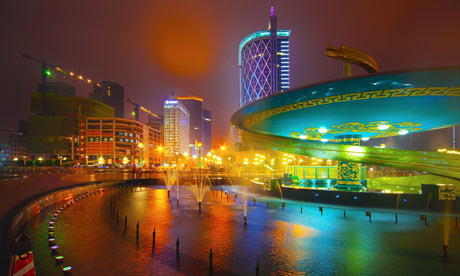
Tianfu Square in the centre of Chengdu, one of China’s fastest growing cities. Photograph: Ed Freeman/Getty Images
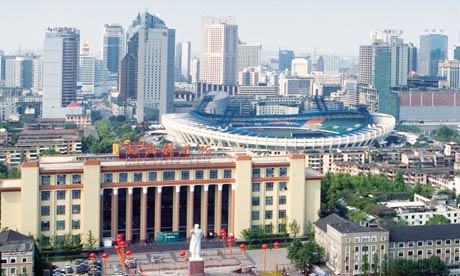
Amid a clutter of 24-hour arc lights, gigantic cranes and dumper trucks, a behemoth is rising out of a field of churned mud on the outskirts of Chengdu in south-west China. Commuters skirt its vast perimeter fence on their way to the new metro link that cuts under the city. They barely glance at what looks like just another huge construction project in a cityscape that changes every month.
via How the rise of the megacity is changing the way we live | Society | The Observer.
January 23, 2012
Video Release – Liquid Stone: Unlocking Gaudí’s Secrets
Circe Films 2009 / 52min. / Catalan with English subtitles.
Director Polly Watkins. Producers James Frankham, Beth Frey.
The Sagrada Família Church in Barcelona is Antoni Gaudí’s most ambitious creation. Begun in the 19th century, it is still under construction today. Gaudí spent 43 years of his life working on the church. When he realised it would not be completed within in his lifetime, he left intricate design models encoded with an ingenious geometrical system that would enable future generations to complete it.
With Gaudí’s untimely death in 1926 and the destruction of the precious models during the Spanish Civil War, coupled with a sculptural style of building that was utterly unique, the task of continuing posed a daunting enigma for those who followed. No-one understood the complex geometry needed to interpret the models and translate them into ways of building.
In 1979, 23-year old New Zealand architect Mark Burry met two of the directors who had worked with Gaudí and was offered the chance to unlock the master’s code. Slowly he began graphically recreating Gaudi’s plans by hand. To speed up this time-consuming process, Burry then took the innovative step of applying aeronautical software which transformed the long process ahead and revealed the astonishing constructive genius of Gaudí’s design.
January 19, 2012
Scripting Cultures
While many designers are now aware of scripting’s potential, it is still seen as a difficult arena to enter. Scripting Cultures treats scripting not only as a technical challenge that requires clear description, guidance, and training, but also, and more crucially, it answers why the designer would script in the first place and what the cultural and theoretical implications are. The book also refers readers to a website where they are able to download all the code, explanations, and tutorials to assist with the worked examples.
January 15, 2012
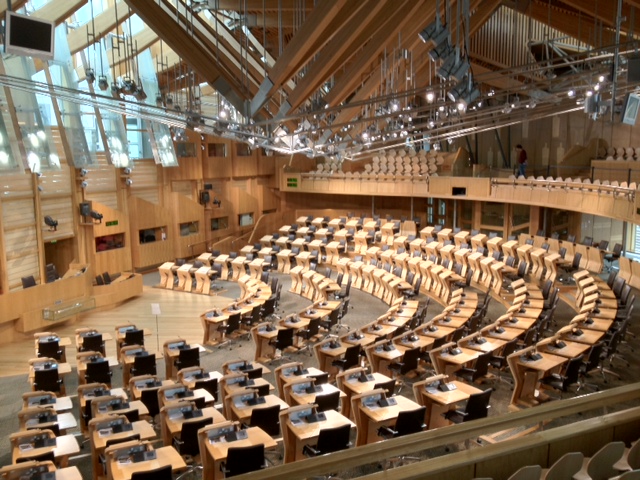
Scottish Parliament
photo
Overwrought? Would make a good lecture theatre…
Sent from my mobile – might be a tad clumsy!
January 12, 2012
In–finite Architectures – Architecture – Domus
In–finite Architectures
In–finite Architectures
An architecture report from Barcelona by Oscar Tusquets Blanca
In Barcelona, the Sagrada Família by Antoni Gaudí
At the start of 2002, to mark the 150th anniversary of the birth of the architect Antoni Gaudí, Domus asked me to write an article on the controversial issue of the continuation of construction work on the Sagrada Família Church. Published in May of that year, my article explained that, in the early 1960s, while I was still at university, I had been one of the instigators of a manifesto against the continuation of the church, which received the unconditional support of all the intelligentsia of the day—from Bruno Zevi to Giulio Carlo Argan, Alvar Aalto and Le Corbusier. The reaction to its publication was overwhelming and we were labelled as Marxist heretics. That year, public donations broke all records and those in charge of building felt this gave them more legitimacy than ever, not only before God (which they had never doubted) but also before men of good faith. In 2002, the question was no longer whether the construction, by then at an advanced stage and which no one would dare demolish, should be continued but how it should be finished.
Mark Burry

My activities as Founding Director of Swinburne University of Technology's Smart Cities Research Institute can be followed via the 'Smart Cities Research Institute' link below.
This site does not purport to talk for Swinburne University of Technology and its overarching research mission - also linked below.
Smart Cities Research Institute

Watch this space...
Swinburne University of Technology

 MARK BURRY
March 25, 2012
0 Comments