
Archive | Uncategorized RSS feed for this archive
The originality of the species | Books | The Guardian
March 24, 2012
http://www.guardian.co.uk/books/2012/mar/23/originality-of-species-ian-mcewan
– might be a tad clumsy!
Living on the fringe can make people sick
March 20, 2012
Living on the fringe can make people sick
March 15, 2012
OPINION
Read later
Public health must be an objective of urban planning.
AFFORDABLE housing is something that every state government likes to say it has delivered, and every opposition likes to say is no longer attainable. The prospect that home ownership might slip from the grasp of most people is so potent a political threat that in recent decades governments of both persuasions have yielded to pressure from developers to release cheap new land on the urban fringe.
As we report today, however, the relentless expansion of the urban boundary is itself imposing a massive cost on taxpayers, in the form of chronic health and social problems in the new suburbs.
In evidence presented to the Legislative Council’s environment and planning committee, outer suburban councils have presented an alarming picture of poorly planned housing developments without basic community services. In parts of the City of Wyndham in Melbourne’s west – the fastest growing municipality in Australia in percentage terms – people have either no or very little access to public transport, coupled with insufficient parkland and leisure facilities.
Advertisement: Story continues below
The consequence is that they have to use cars for even the simplest trips outside the home. For some residents, a visit to the nearest swimming pool might take 1½ hours on public transport, compared with 15 minutes by car. Some areas are even poorly supplied with supermarkets and other sources of fresh food, making residents reliant on service stations and fast-food outlets.
Frank Gehry: Theres a backlash against me | Art and design | The Observer
February 19, 2012
Frank Gehry: Theres a backlash against meFrank Gehrys success with the Bilbao Guggenheim sparked an inevitable backlash, but, as he says, expression is still vital to architectureShare 18 reddit thisComments 6 Rowan MooreThe Observer, Sunday 19 February 2012Article historyEight Spruce Street, left, the tallest residential building in Manhattan and Gehry?s first skyscraper. Photograph: Wade Zimmerman/Arcaid/CorbisThere are iconic architects and there is the architect who is the icon of iconic architecture. Whether he wanted to or not, Frank Gehry, as the creator of the titanium-clad Bilbao Guggenheim, made the original for 10,000 wannabes – pointy, swooshy, shiny things, would-be masterpieces that proclaimed regeneration for whichever ex-industrial swamp or intended megalopolis that happened to host them. He was feted in magazines and film and by an appearance on The Simpsons. He became the epitome of the idea – again, without much reference to his own wishes – that genius in architecture lies in spectacular shape-making.Then there was the inevitable reaction. Iconic architecture came to be seen as wasteful, extravagant, unsustainable and, worse, a gaudy distraction from the dark financial forces for which it was a bauble. It seemed perfectly to encapsulate the great pre-crash deception, by offering only the appearance of glamour and prosperity. According to the art critic Hal Foster, Gehrys Walt Disney concert hall in Los Angeles is a “media logo” and his style of architecture is a “winning formula” for “any corporate entity that desires to be perceived, through an instant icon, as a global player”. Someone started selling T-shirts saying “Fuck Frank Gehry” and he bought some.Not that he or his office seem unduly perturbed by the change in the critical wind. Recently his Signature theatre in New York opened, one of several projects in a city that once shunned him. Last year he completed the New World Symphony, a complex of performance and rehearsal spaces, in Miami. He finished his first skyscraper, in Spruce Street, Lower Manhattan.
via Frank Gehry: Theres a backlash against me | Art and design | The Observer.
How the rise of the megacity is changing the way we live | Society | The Observer
January 28, 2012
How the rise of the megacity is changing the way we live
The rapid increase in the number of cities home to more than 10 million people will bring huge challenges … and opportunities
Click here for a graphic charting the rise of the megacity
reddit this
Comments (106)
Paul Webster in Chengdu and Jason Burke in Delhi
guardian.co.uk, Saturday 21 January 2012 22.52 GMT
Article history
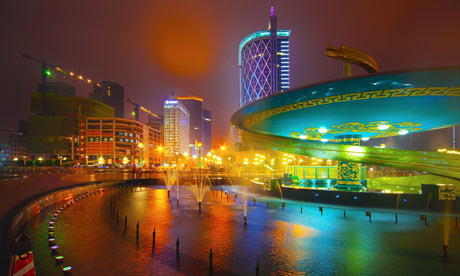
Tianfu Square in the centre of Chengdu, one of China’s fastest growing cities. Photograph: Ed Freeman/Getty Images
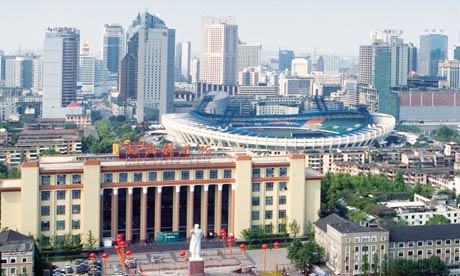
Amid a clutter of 24-hour arc lights, gigantic cranes and dumper trucks, a behemoth is rising out of a field of churned mud on the outskirts of Chengdu in south-west China. Commuters skirt its vast perimeter fence on their way to the new metro link that cuts under the city. They barely glance at what looks like just another huge construction project in a cityscape that changes every month.
via How the rise of the megacity is changing the way we live | Society | The Observer.


Mark Burry

My activities as Founding Director of Swinburne University of Technology's Smart Cities Research Institute can be followed via the 'Smart Cities Research Institute' link below.
This site does not purport to talk for Swinburne University of Technology and its overarching research mission - also linked below.
Smart Cities Research Institute

Watch this space...
Swinburne University of Technology

 MARK BURRY
March 25, 2012
0 Comments